
An evaporative cooler blows warm air when water isn’t reaching the cooling pads, when there isn’t enough airflow through the house, or when the outside humidity is too high for evaporation to do much. The most common causes are the unit being left in fan-only mode, a closed water supply valve, a failed pump, dry or mineral-clogged pads, and too few open windows.
Most of these problems are things you can check yourself in a few minutes, and a fair number turn out to be settings rather than faults. Below is the order we work through them, what each symptom usually means, and when it’s worth calling a technician.
.

How do I Fix an Evaporative Cooler That Isn’t Blowing Cold Air?
Work through these five checks in order before booking an evaporative cooler service:
- Check the mode: Make sure the cooler is set to cool, not fan or vent only. Without the pump running, the unit is just a large fan.
- Wait out the start-up delay: The pads need to soak before cool air arrives. Give it several minutes from switch-on.
- Open more windows and doors: Evaporative cooling needs air to flow out of the house as fast as it flows in.
- Check the water supply: Confirm the isolation valve feeding the cooler is open. No water means no cooling.
- Look at the pads: If the unit has been running for ten minutes and the pads are still dry, the problem is in the water system.
If all five check out and the air is still warm, the fault is mechanical and needs a technician.
Common User Errors
Before you call up for an evaporative air conditioning service, make sure you double-check some common user errors that might cause your evaporative cooler to stop cooling. These quick fixes could save you time and money.
Is the unit in fan-only mode?
Your evaporative cooler can work as a whole-house fan in fan-only mode, but you need both the fan and water pump running to cool your space. Running your cooler with just the fan setting can be effective on days where the humidity climbs. On dry summer days, without water circulating through the cooling pads, your unit just pushes warm air around your home.
Have you waited for the startup delay?
Cool air doesn’t flow right away, which can be worrying and make you think your cooler isn’t working. Most systems include pre-programmed function times that delay the cool airflow through your ducts to let your tank fill with water and soak the filter pads. Depending on your model, it might take up to 10 minutes before cool air starts flowing from the ducts.
Are enough windows or doors open?
Unlike traditional ACs, your evaporative cooler needs continuous airflow. Your home needs open windows and doors for the system to work properly, and not having enough openings creates several issues:
- The cooling becomes less effective as air gets trapped
- The fan motor works harder than it should
- Moisture can build up and dampen your walls, ceilings, and furniture
Your evaporative cooler needs fresh air coming in and warm air going out. Open windows on the opposite side of your cooled air entry points to create the cross-ventilation you need for the best cooling.
Why Are My Evaporative Cooling Pads Dry?
Dry cooling pads mean water isn’t reaching them, and there are only three places that goes wrong: the water supply into the cooler, the pump that lifts water onto the pads, or the lines and spray bar that distribute it. Dry pads produce warm air, weak airflow and uneven cooling through the house.
Dry pads or low water levels
Ducted evaporative coolers are plumbed to mains water and refill the sump automatically through a float valve or solenoid, so you shouldn’t ever need to top one up. If the sump is running low, the cause is upstream: a closed isolation valve, a solenoid that isn’t opening, or a float valve stuck shut.
Check that the water valve feeding the cooler is open before assuming a fault in the unit.
Pump not circulating water
The water pump sends water to your cooling pads, so cooling drops when the pump fails and leaves the pads dry. Here are common pump issues:
- Electrical problems like blown fuses or damaged wiring
- Pump motor failure
- Mechanical damage
Strange noises like grinding or rattling often mean worn bearings or a loose impeller. Water leaks around your unit usually point to pump connection problems.
Clogged or blocked water lines
Mineral deposits cause most blocked water lines in evaporative coolers. These blockages limit water flow to the cooling pads and reduce cooling efficiency significantly.
Minerals build up over time, creating uneven water distribution that leaves dry patches on pads and causes spotty cooling. The spray bar and pump inlet often get clogged, so check these areas first.

Why is the Airflow From My Evaporative Cooler Weak?
Weak airflow from an evaporative cooler usually comes from one of three things: a failing fan motor, pads so clogged with dirt and minerals that air can’t pass through them, or ductwork that has come apart or is leaking. Unlike a water fault, these generally can’t be fixed without a technician.
Fan motor not working properly
A struggling motor leads to weak or warm airflow throughout your home. You might hear grinding, rattling, or unusual noises that signal worn-out bearings or loose components. The cooler becomes sluggish to start or stops responding completely when the motor fails.
Blocked or dirty filter pads
Dirt and mineral deposits in filter pads restrict airflow significantly. This creates:
- Reduced cooling efficiency
- Uneven temperature distribution
- Higher energy consumption
Your pads need replacement when they look discoloured, cracked or brittle.
Disconnected or leaking ducts
Ductwork problems cause uneven cooling, making your system work harder to keep your home comfortable. Airflow drops dramatically from collapsed or detached ducts, while leaks decrease pressure and waste cool air. Your system works harder when furniture blocks vents and restricts airflow.
Environmental Factors
Even well-managed evaporative cooling systems can run into trouble from outside factors.
Does humidity stop an evaporative cooler from working?
Humidity doesn’t stop an evaporative cooler, but it reduces how much cooling it can deliver. These systems cool by evaporating water into the air, and the drier the incoming air, the more water it can absorb and the more heat it carries away. As humidity rises, the air has less capacity to take on moisture, so the temperature drop shrinks.
There’s no single cut-off point where a cooler stops working. Performance simply tapers as the air gets more humid. It’s why the same system that feels excellent on a dry 35°C day can feel underwhelming on a muggy one, with nothing actually wrong with it.
How Much Can an Evaporative Cooler Cool a House?
In dry conditions, an evaporative cooler can drop the air temperature by up to around 10°C. Importantly, it cools by a temperature difference rather than to a set target, so it doesn’t work like a thermostat. If it’s 38°C outside, expect indoor air around 28°C, not 22°C.
That also explains why extreme heat feels like a failure. Above 40°C, the same 10°C drop still leaves the house warm, even though the system is performing exactly as designed.
Let Us Take Care of the Troubleshooting!
Knowing these common issues can help keep your evaporative cooler in great condition, but even the most well-maintained system needs professional attention.
Here at Air Conditioning Doctor, we’ve fixed countless struggling evaporative coolers and know exactly what makes them work right. Our skilled technicians can spot if your evaporative air conditioner problems come from mechanical failures, airflow issues, or environmental challenges. We’ll give you a full picture of your evaporative cooling system’s health, fixing any current problems and showing you how to prevent future ones.
Don’t swelter for another summer. Call the experts at Air Conditioning Doctor today to get the cool air flowing again in no time. Reach out to us today for a tailored quote and some expert advice.
Frequently Asked Questions
Why is my evaporative cooler blowing hot air?
Almost always because the pads are dry or the unit is in fan-only mode. With no water evaporating, the cooler draws in outside air and delivers it at close to outside temperature.
Should I run my evaporative cooler with the windows open or closed?
Open. Evaporative cooling relies on a constant flow of fresh air through the house. Closing the windows traps humid air, reduces cooling and can cause condensation on walls and furniture.
Can an evaporative cooler work in humid weather?
It still moves air, but it cools far less. On humid days, many people run the fan without the pump, which circulates air without adding moisture to the house.
Why does my evaporative cooler smell?
Usually stagnant water in the sump or pads that are past their life. A pre-season service that drains and cleans the sump and checks the pads clears it in most cases.
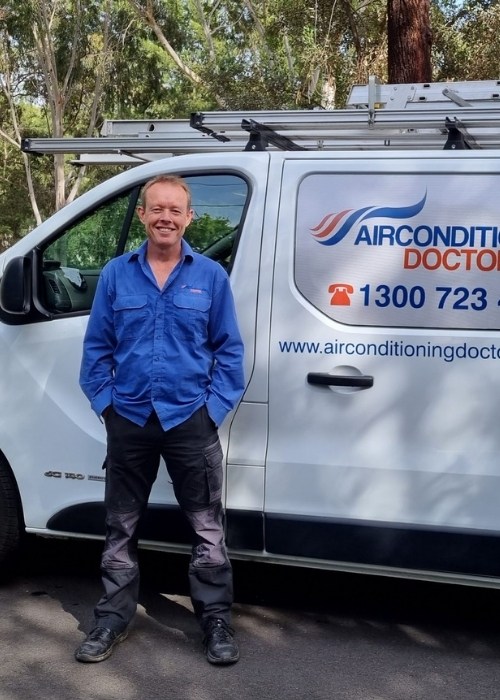
Stephen Maitland is the Director of Air Conditioning Doctor and has over 20 years of experience in the refrigeration and air conditioning industry. He founded the company in 2007 to be Adelaide’s leading air conditioning repair, replacement and installation specialist.
As a certified Refrigeration Mechanic with a full unrestricted ARC license, his technical knowledge and years of experience allow him to diagnose problems quickly and offer practical and efficient solutions for his customers.
