
You can replace evaporative cooling with refrigerated air conditioning in most homes, but you can’t convert one into the other. The ductwork, ceiling outlets and return air design are all different, so switching means a complete new installation rather than a changeover of the rooftop unit. The existing evaporative ducting has to come out.
Evaporative cooling suits Adelaide’s dry summers well, but plenty of homeowners eventually look at refrigerated air conditioning instead. Below is what the switch actually involves, why the existing ducts can’t be reused, and what your alternatives are if a full changeover isn’t worth it.
Why Can’t You Reuse Evaporative Ductwork For Refrigerated Cooling?
Evaporative and refrigerated systems move air in fundamentally different ways, so the ducts, outlets and airflow design have nothing in common beyond both being in your ceiling.
The ducts are the wrong size
Evaporative cooling works by moving a very large volume of air at low pressure, which is why it uses larger ducts. Refrigerated systems do the opposite: they move a smaller volume of air at high static pressure through narrower, precisely sized ducts. Push refrigerated air through oversized evaporative ducting and the pressure drops away, the system can’t maintain airflow, and you risk the unit freezing up or failing.
The ducts aren’t insulated
Evaporative ducting doesn’t need insulation because it carries air that’s close to outdoor temperature. Refrigerated ducting carries much colder air, so it has to be insulated and sealed to standard, or condensation forms on the outside of the ducts in your ceiling cavity.
There’s no return air
An evaporative cooler pushes fresh outside air in and that air leaves through your open windows. A refrigerated system recirculates, drawing indoor air back through a return air grille, cools it, and sends it out again. That return air ducting doesn’t exist in an evaporative-only home, so it has to be designed and installed as part of the switch.
The outlets are in the wrong places
Evaporative outlets are positioned to push air across a room and out through an open window. Refrigerated outlets are positioned to circulate air within a closed room and return it to the grille.
Connect a refrigerated system to evaporative outlets, and the cooled air takes the shortest path straight back to the return air grille. You end up with one comfortable spot and the rest of the house barely cooled at all. It’s worth knowing that some installers will offer to do exactly this to save costs. It doesn’t work, and it’s not a corner worth cutting.
What’s Involved in Switching From Evaporative to Refrigerated?
A changeover is a full installation. The usual sequence:
- Remove the evaporative unit from the roof and make the roof penetration weathertight
- Remove the existing ductwork and ceiling outlets, and patch the ceiling
- Design a new duct layout, zone plan and return air path for the home
- Install the new indoor and outdoor units, insulated ductwork, outlets and return air grille
- Complete the electrical work and commission the system
Because it involves removing old hardware as well as installing new, it’s a bigger job than putting ducted air conditioning into a home that has never had it.
What Happens to the Evaporative Unit on the Roof?
It comes off, and the hole it leaves has to be made weathertight. On a tiled roof, that usually means re-tiling the gap, which is straightforward if you have matching spare tiles.
Some homeowners choose to leave the old cooler sitting on the roof rather than pay to remove it. It saves a little upfront, but it leaves an ageing unit and an unused penetration on your roof, which is a leak waiting to happen. Removing it properly is the cleaner outcome.
Can I Install Both Evaporative Cooling and Ducted Air Conditioning?
Yes, absolutely! Ducted air conditioning and evaporative cooling are two very different technologies. And, while they can’t operate using the same ductwork, there’s no reason you can’t have both types of systems in your home.
The challenge is that both systems take up space in the ceiling cavity. The ductwork and internal components required for both types of cooling may not fit inside your ceiling. You’ll need to talk to an air conditioning technician to find out if you have sufficient space to install two sets of ductwork.
If you don’t have enough ceiling space, your installer may be able to place air conditioning ducts under the floor, but this depends on the construction of your home.


Can I Run an Evaporative Cooler and a Reverse Cycle Air Conditioner at the Same Time?
No. There’s no point in running evaporative cooling while your reverse cycle air conditioning is turned on.
This is because evaporative cooling requires you to open doors and windows to create airflow and prevent buildups of humid air. On the other hand, refrigerative air conditioners work best when you shut your doors and windows to contain the conditioned air.
What are the Alternatives to a Full Changeover?
A complete switch isn’t the only option, and it isn’t always the best value.
Replace the evaporative system like for like
If the ductwork is in good condition and not too old, a new evaporative unit can often use the existing ducts and outlets. It’s by far the cheapest path, and a new unit will cool considerably better than a tired one.
Keep the evaporative and add split systems
Split systems need no ductwork at all, which sidesteps the ceiling space problem entirely. Adding refrigerated cooling to a bedroom or living area gives you somewhere properly cool on humid days, while the evaporative system keeps handling the dry heat cheaply. For a lot of homes this is the sensible middle ground.
Switch to reverse cycle for the heating as well
If you’re also running gas ducted heating, replacing both with a single reverse cycle system changes the maths considerably. You’re removing two systems and their running costs, not one.
How to Make Your Evaporative Cooler More Effective
Run it on hot, dry days rather than humid ones, keep internal doors and some external windows open so air can move through the house, and have it serviced before each summer.
- Use evaporative cooling on hot, dry days – Evaporative coolers perform better on hot days when the relative humidity is low. Your cooler will perform best at a relative humidity of 50% or less. Ducted reverse cycle air conditioning may be the better choice if you live in a humid area.
- Keep doors and windows open – It’s important to understand that evaporative cooling uses air flow to lower the temperature inside your house. While running the system, you need to open internal doors and some external windows. This creates cross-ventilation and lowers the internal temperature.
- Invest in a yearly evaporative air conditioner service – Your evaporative cooler is a simple system with very few moving parts. But components like the filter pads wear out during normal use, and they may become clogged by calcium and mineral deposits. Annual servicing ensures your evaporative cooler is always performing at its best.

Improve Your Evaporative Cooler with Servicing from the Air Conditioning Doctor!
Staying comfortable during the Adelaide summer is never easy. When you’re dealing with hot and dry conditions, evaporative and refrigerated cooling are both excellent ways to keep cool.
While evaporative coolers are affordable, efficient and very effective, they don’t work in the same way as refrigerated air conditioning. That means you can’t expect to get the same cooling power from your system.
If you want to improve the performance of your evaporative cooling system, yearly servicing from the Air Conditioning Doctor is your best bet!
The Air Conditioning Doctor is a team of experienced technicians who work throughout Adelaide. We service, maintain and repair evaporative cooling and refrigerated air conditioning systems. If your evaporative cooler isn’t cutting it, our servicing program will ensure you’re always getting the best performance possible.
Contact us today to book an air conditioner service in Adelaide with the Air Conditioning Doctor!
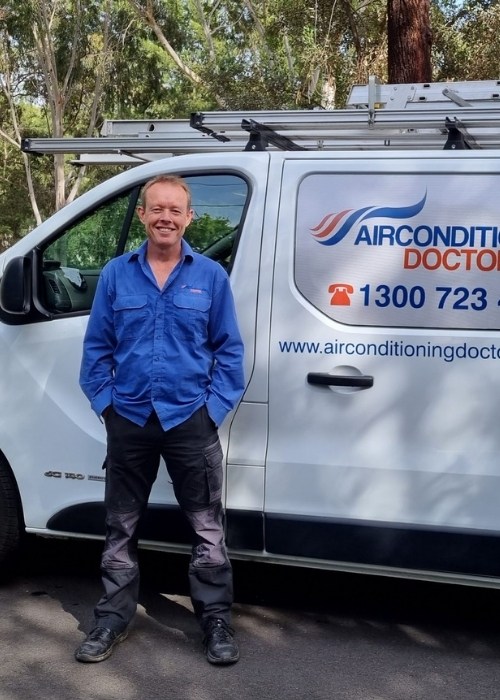
Stephen Maitland is the Director of Air Conditioning Doctor and has over 20 years of experience in the refrigeration and air conditioning industry. He founded the company in 2007 to be Adelaide’s leading air conditioning repair, replacement and installation specialist.
As a certified Refrigeration Mechanic with a full unrestricted ARC license, his technical knowledge and years of experience allow him to diagnose problems quickly and offer practical and efficient solutions for his customers.
