
Summers are getting hotter, and energy prices keep climbing. Adelaide homeowners need to understand the energy efficiency of each system to make the best choice between evaporative vs refrigerated cooling systems. The difference in expenses is substantial, with evaporative cooling systems using up to 80% less energy than refrigerated air conditioning.
This piece breaks down the energy efficiency, running costs, environmental impact, and overall expenses of both cooling systems to help you make the best decision for your home.
Understanding Evaporative and Refrigerated Cooling Systems
Evaporative cooling basics
Evaporative coolers operate on a straightforward principle: water evaporation cools air. The system draws hot outside air through water-saturated filter pads. Water evaporates from these pads and absorbs heat from the air before sending the newly cooled air throughout your home. It’s a simple process, but it can cut the temperature inside your home by up to 15 degrees, making those uncomfortably 40°C a much more bearable 25°C. Evaporative coolers do need constant fresh air flow so the cooled air can circulate through and exit your home.
Climate matters substantially since evaporative cooling performs best when humidity stays low. Adelaide’s dry climate makes evaporative systems effective, though their performance can drop on humid days when water evaporates less from the cooling pads.
Refrigerated air conditioning basics
Refrigerated systems like split systems or ducted air conditioners rely on a refrigeration cycle that absorbs heat from indoor air and expels it outside. The refrigerant circulates through the system, changing from liquid to gas and back again.
When warm indoor air passes over the evaporator coils, refrigerant inside these coils absorbs heat and boils, transforming from cold liquid to warm gas. The compressor then compresses this gas before it moves to the condenser, where heat is released outdoors and the refrigerant returns to liquid form again.
Split systems are ideal for cooling specific rooms, while ducted systems distribute refrigerated air throughout your entire home via ceiling or underfloor ductwork. Both types require sealed environments with closed windows and external doors, creating controlled indoor temperatures regardless of the outside conditions.
Energy efficiency: power needs and consumption
How much electricity each system uses
There’s a big gap in power consumption between evaporative coolers and refrigerated air conditioners. Evaporative coolers are very simple systems that only run a fan and a small water pump, so they usually use around 200 to 400 watts of electricity while operating. Larger units may use a little more, but they’re still relatively low-power appliances.
Refrigerated air conditioners, on the other hand, might use around 1 to 3 kilowatts, mostly because they rely on a compressor to actively cool the air. While modern refrigerated systems are designed to be energy efficient, they still consume significantly more electricity than evaporative coolers. In many homes, an evaporative cooler can use up to 70–75% less electricity than a refrigerated air conditioner, which can make a big difference on your power bills.
Component power requirements
The energy efficiency gap largely comes down to component differences. Evaporative cooling systems only require electricity for the fan motor, water pump and control electronics. Refrigerated air conditioning systems require significantly more power because they operate a vapour-compression refrigeration cycle.
In most systems, the compressor accounts for roughly 60–85% of total operating energy. Additional components also contribute to power consumption. Outdoor condenser fans typically draw around 60–300W depending on system size, while indoor blower fans use between 30–120W in wall split systems or up to 600W in large ducted units. Control electronics generally add another 5–30W.
For example, a typical 3.5kW split system may run its compressor at roughly 800–1,400W in fixed-speed systems, with indoor and outdoor fans adding a combined 100–250W depending on operating speed.
Energy ratings and efficiency standards
Since 2020, new air conditioners must display Zoned Energy Rating Labels showing separate star ratings for different climate zones. Adelaide falls in the hot zone, meaning each extra star cuts annual energy consumption by up to 25%. A 5kW split system with 6 stars in the hot zone uses around 550 kilowatt-hours annually for cooling, while a 3-star unit of similar size might consume 850 kWh yearly.
Cost analysis: installation and ongoing expenses
Setup costs
Installation costs can vary significantly between evaporative and refrigerated cooling systems. Ducted evaporative cooling typically costs between $3,500 and $7,500 installed for most Australian homes.
Refrigerated split systems generally cost $1,800 to $4,500 installed, depending on the brand, capacity, and installation complexity. Ducted refrigerated air conditioning is the most expensive option, usually starting around $10,000 and reaching up to $30,000 or more for large homes.
Daily and monthly running costs
Evaporative coolers are very efficient and inexpensive to run. Most systems typically cost around 10 to 25 cents per hour in electricity. Over a hot Adelaide day, running an evaporative cooler can cost around $2 to $7 per day, including both electricity and water use.
Refrigerated air conditioning systems use significantly more power because they rely on a compressor. As a result, they generally cost several times more per hour to operate than evaporative cooling.
Annual electricity bill comparison
Annual running costs show a clear difference between the two systems. Evaporative cooling typically costs around $250 to $500 per year to run, depending on how often the system is used. Refrigerated air conditioning uses significantly more electricity, with annual running costs generally ranging from $900 to $3,000 or more for larger homes.
Maintenance expenses
Maintenance costs also vary between the systems. Evaporative coolers usually require $200 to $500 per year for cleaning, servicing, and pad maintenance. Refrigerated systems typically cost $150 to $400 per year for routine servicing. If repairs are required, costs can vary widely depending on the issue, with most repairs ranging from $200 to $1,500 or more.
Sustainability and environmental performance
Carbon emissions
Evaporative systems produce approximately 20% of the carbon emissions generated by standard refrigerated air conditioning. This reduction stems from lower electricity consumption, which means fewer fossil fuels are burned to meet your cooling needs.
Renewable energy compatibility
Solar-powered air conditioning works well with evaporative systems. The reduced evaporative cooler power consumption pairs naturally with rooftop solar panels, allowing Adelaide homes to run cooling on clean energy during peak daylight hours. Refrigerated systems need much more solar capacity to offset their higher consumption.
Chemical refrigerants vs natural cooling
Refrigerated systems rely on hydrofluorocarbon refrigerants with severe environmental damage. One kilogram of R410a refrigerant has the same greenhouse effect as 2 tons of carbon dioxide. Evaporative cooling uses no harmful synthetic refrigerants and relies only on water as its natural cooling agent.
Fresh air circulation benefits
Evaporative systems pump 100% fresh outdoor air through Adelaide homes. Refrigerated cooling recirculates the same indoor air and potentially traps dust, allergens and airborne particles.
Start Saving with Evaporative Cooling
If you’re deciding between evaporative cooling and refrigerated air conditioning, getting the right advice for your home makes all the difference. The team at Air Conditioning Doctor has been helping Adelaide homeowners choose, install, and maintain efficient cooling systems for over 20 years.
Whether you’re looking to lower running costs or upgrade your current system, we can recommend the best solution for your space and climate.
Contact our team today to book a consultation or request a quote.
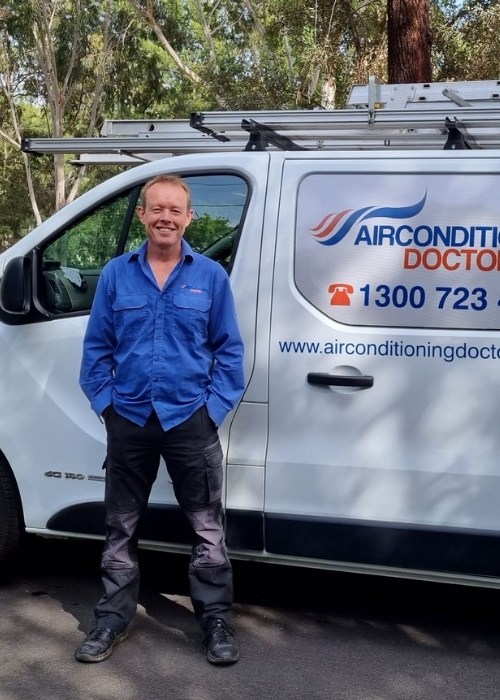
Stephen Maitland is the Director of Air Conditioning Doctor and has over 20 years of experience in the refrigeration and air conditioning industry. He founded the company in 2007 to be Adelaide’s leading air conditioning repair, replacement and installation specialist.
As a certified Refrigeration Mechanic with a full unrestricted ARC license, his technical knowledge and years of experience allow him to diagnose problems quickly and offer practical and efficient solutions for his customers.
